
Is SaaS Being Replaced by GaaS? The Truth Behind the Latest AI Buzz
The software industry is witnessing a major shift. As generative AI changes how businesses build, buy, and use software, a new question is gaining attention: Is Software as a Service (SaaS) becoming obsolete, and is Generative AI as a Service (GaaS) the next big thing?
AI Is Reshaping SaaS—These 2 Software ETFs Offer Different Ways to Play It
For more than two decades, Software as a Service (SaaS) has dominated the software industry. From customer relationship management (CRM) platforms to accounting systems, project management tools, and marketing automation, SaaS has transformed how businesses operate.
However, the rapid advancement of generative artificial intelligence has sparked a new debate across the technology industry: Could GaaS replace SaaS?
Some industry observers believe traditional SaaS applications will lose relevance as AI-powered systems become capable of performing tasks that previously required multiple software subscriptions.
Others argue that AI will not eliminate SaaS but instead fundamentally transform it.
So, what is actually happening? Is SaaS dying, or are we witnessing the beginning of an entirely new software ecosystem?
What Is SaaS (Software as a Service)?
SaaS is a cloud-based software delivery model that allows businesses and individuals to access applications over the internet without installing or maintaining the underlying infrastructure.
Instead of purchasing software licenses and managing installations, customers typically pay monthly or annual subscription fees.
Popular SaaS platforms include:
How to learn Salesforce | TechRadar
Salesforce — Customer relationship management and sales automation.
Slack Announces Record Third Quarter Fiscal Year 2020 Results | Slack
Slack — Workplace communication and collaboration.
Shopify
Shopify — E-commerce website and store management.
HubSpot website builder review 2024: All features tested | TechRadar
HubSpot — Marketing, sales, and customer service automation.
The success of SaaS comes from its convenience, scalability, predictable pricing, and accessibility.
However, traditional SaaS applications generally require users to navigate interfaces, configure workflows, enter information, and perform actions themselves.
This is precisely where generative AI is challenging the established model.
What Is GaaS (Generative AI as a Service)?
GaaS, in the context of this discussion, refers to Generative AI as a Service: cloud-based access to AI models and capabilities that can generate content, analyze information, write code, answer questions, and increasingly execute complex business workflows.
The acronym GaaS is not universally standardized. It is also used for other concepts, including GPU as a Service and Gaming as a Service. In discussions about AI disrupting SaaS, Generative AI as a Service is one relevant interpretation.
Unlike conventional software, where users typically operate predefined functions, generative AI systems can interpret natural-language instructions and produce customized outputs.
For example, instead of opening five different applications to research competitors, analyze data, prepare a report, create a presentation, and draft an email, a user may increasingly accomplish these activities through one AI-powered workflow.
Examples of the emerging GaaS ecosystem include generative AI APIs, enterprise AI platforms, AI assistants, and agent-building services offered by companies such as OpenAI, Google Cloud, Microsoft, and Anthropic.
The fundamental shift is from software that provides tools to AI systems that help deliver completed work.
SaaS vs. GaaS: Understanding the Key Differences
| Feature | SaaS | GaaS |
|---|---|---|
| Core offering | Ready-to-use software applications | Generative AI capabilities and services |
| Interaction | Menus, dashboards, forms | Natural language, APIs, AI agents |
| Automation | Rules and predefined workflows | Adaptive, AI-driven workflows |
| Customization | Configuration and integrations | Prompts, context, models, tools |
| Pricing | Often per user or subscription | Often usage, tokens, or consumption |
| Main value | Access to software functionality | Generated outputs and task execution |
| Limitations | Fixed application capabilities | Accuracy, reliability, cost, governance |
These are broad distinctions, not absolute rules. Modern SaaS products increasingly incorporate generative AI, while many GaaS offerings themselves use subscription pricing.
Why Is Everyone Talking About GaaS Replacing SaaS?
The buzz surrounding the potential replacement of SaaS is driven by several important developments.
1. AI agents are changing how software is used
Traditional SaaS applications are designed around human interaction.
A sales representative logs into a CRM, updates customer records, prepares follow-up emails, and manages opportunities.
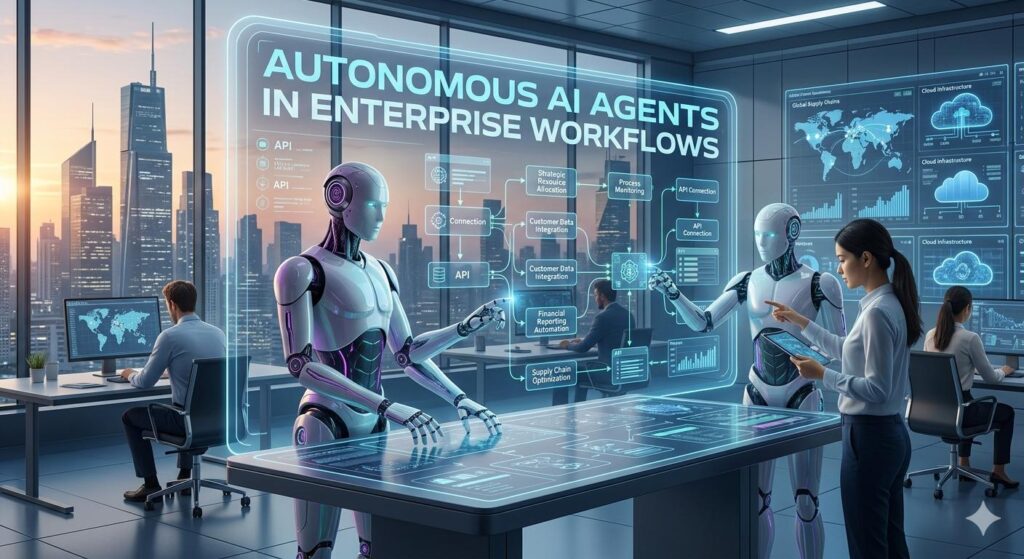
An AI agent, by contrast, can potentially coordinate many of these activities automatically when connected to the necessary systems and granted appropriate permissions.
The Rise of Autonomous AI Agents in Enterprise Workflows — MaGeN-AI
Imagine a business owner telling an AI assistant:
Analyze our sales performance for the last six months, identify customers at risk of leaving, prepare personalized retention emails, and create a management report.
Previously, this might have required several applications and substantial manual effort.
With AI-powered automation, much of the process can be orchestrated through a single interface, although data access, approvals, verification, and integrations remain necessary.
This raises an important question: If AI can operate the software on behalf of users, how much time will users need to spend inside traditional SaaS interfaces?
2. Businesses are questioning multiple software subscriptions
Many organizations subscribe to numerous SaaS products for different business functions.
They may use separate tools for:
- Content creation and SEO
- CRM and sales management
- Customer support
- Data analysis and reporting
- Project management
- Marketing automation
As AI capabilities improve, businesses are exploring whether some of these functions can be consolidated.
Instead of paying for several specialized applications, a company might use an AI platform integrated with its existing business systems.
However, consolidation is not guaranteed to reduce costs. AI inference, integrations, monitoring, security, and maintenance can also be expensive.
3. Natural language is becoming a new software interface
One of the biggest advantages of generative AI is its ability to understand instructions written in everyday language.
Traditional software often requires users to learn how a particular application works.
AI-powered software increasingly allows users to describe what they want to accomplish.
For example:
Traditional SaaS approach: Open an analytics dashboard, select metrics, apply filters, export results, and manually interpret the findings.
AI-powered approach: Ask, “Why did our sales decrease last month, and what should we do to improve them?”
An AI system with access to reliable business data may generate an initial analysis and recommend actions.
This transition could significantly reduce the need for complicated dashboards and repetitive manual processes.
4. AI is accelerating software development
Generative AI can help developers write code, generate tests, troubleshoot errors, and build prototypes.
This creates another potential challenge for SaaS companies.
Businesses that previously purchased specialized software may find it increasingly practical to develop certain internal tools using AI-assisted development.
For example, a small company might build a custom inventory dashboard or internal reporting application rather than purchasing a separate SaaS subscription.
Nevertheless, production software still requires security, maintenance, compliance, hosting, testing, and ongoing support.
AI makes building software easier, but it does not eliminate the responsibilities associated with operating it.
Is SaaS Really Dying?
No. SaaS is not disappearing, but its traditional business model and user experience are under pressure.
The claim that GaaS will completely replace SaaS oversimplifies the situation.
Many businesses depend on SaaS platforms for critical operations, including financial records, customer databases, identity management, compliance, and enterprise resource planning.
Generative AI does not automatically replace these underlying systems.
In fact, AI agents often need SaaS applications to store information, retrieve records, enforce permissions, and execute transactions.
This suggests that the future may involve a division between two layers:
AI agent / GaaS layer
Understands instructions, reasons, generates outputs, coordinates tasks
APIs • Permissions • Integrations
CRM
ERP
Finance
SaaS systems of record and business infrastructure
In this scenario, SaaS remains essential infrastructure while AI becomes the primary interface through which people interact with it.
The real disruption may not be the disappearance of SaaS platforms, but the decline of traditional software interfaces as the main way users accomplish work.
Which SaaS Categories Are Most Vulnerable to AI Disruption?
Not every SaaS category faces the same level of risk.
Some applications primarily provide lightweight functionality that generative AI can increasingly reproduce. Others manage complex infrastructure, proprietary data, and mission-critical operations.
| SaaS category | Potential AI disruption |
|---|---|
| Basic content writing tools | High |
| Simple summarization and transcription tools | High |
| Basic reporting and dashboard tools | Medium–High |
| Customer support software | Medium–High |
| Marketing automation platforms | Medium |
| CRM platforms | Medium |
| Accounting and financial systems | Lower for core systems |
| Enterprise ERP platforms | Lower for core systems |
Illustrative assessment of exposure to AI-driven feature substitution, not a measured industry forecast. Actual risk depends on product differentiation, integrations, customer requirements, and execution.
A simple AI writing application may face substantial competition from general-purpose AI assistants.
On the other hand, an enterprise accounting platform must maintain financial accuracy, audit trails, regulatory compliance, and reliable transaction processing.
Generative AI may improve these systems without replacing their essential functions.
The Rise of AI Agents: A Bigger Threat Than GaaS Alone?
While GaaS is an important concept, the rise of agentic AI may be even more significant for the future of software.
Generative AI primarily focuses on producing outputs such as text, code, images, and analysis.
Agentic AI extends this capability by planning actions, interacting with tools, and executing multi-step workflows.
For example, an AI-powered sales agent might:
- Identify potential leads from approved data sources.
- Research prospects and their businesses.
- Draft personalized outreach messages.
- Update CRM records.
- Schedule follow-up activities.
- Produce performance reports.
The agent still requires reliable systems, permissions, and human oversight, particularly for customer-facing actions.
But it changes how software delivers value.
Instead of selling access to individual features, vendors may increasingly sell automation and measurable business outcomes.
This leads to another emerging idea: outcome-based software pricing.
Businesses may prefer paying for completed tasks, resolved support cases, or qualified leads rather than simply paying for the number of employees who can access an application.
That does not mean seat-based subscriptions will disappear. It means software vendors may experiment with hybrid pricing models combining subscriptions, usage, and outcomes.
Will GaaS Replace SaaS by 2030?
Predictions that SaaS will be completely replaced by GaaS by 2030 should be treated with skepticism.
There is no established industry consensus supporting a precise replacement date.
A more realistic scenario is that AI will transform how SaaS products are designed, purchased, and monetized.
Three possible developments stand out.
AI-native SaaS platforms
Existing SaaS providers will increasingly embed AI agents, natural-language interfaces, and automated workflows directly into their applications.
AI orchestration platforms
Businesses may adopt centralized AI interfaces that coordinate activities across multiple applications, reducing the need to operate each tool manually.
Hybrid business models
Software companies may combine traditional subscriptions with AI usage charges, automation fees, and outcome-based pricing.
These scenarios are not mutually exclusive. Many companies will likely combine elements of all three.
What Should SaaS Companies Do to Survive the AI Revolution?
The emergence of GaaS should not be viewed only as a threat. It also creates significant opportunities for software providers willing to adapt.
SaaS companies should consider several strategic priorities.
Integrate AI into core workflows. Rather than adding an AI chatbot merely for marketing purposes, companies should identify tasks where AI can meaningfully improve productivity, accuracy, or customer experience.
Build AI-ready APIs and integrations. Software that can be securely accessed and operated by AI agents may become more valuable in an increasingly automated business environment.
Focus on proprietary data and domain expertise. Generic features are easier to replicate than deeply integrated business processes, specialized knowledge, and trusted datasets.
Simplify the user experience. Natural-language interactions and intelligent automation can reduce unnecessary complexity in software interfaces.
Experiment with flexible pricing. Businesses should evaluate whether subscription, consumption, and outcome-based models better reflect the value their products deliver.
Prioritize trust and reliability. Security, compliance, auditability, human oversight, and predictable performance will remain essential competitive advantages.
The winners may not be companies that abandon SaaS, but those that successfully combine dependable software infrastructure with powerful AI capabilities.
SaaS vs. GaaS: Competition or Collaboration?
The discussion is often framed as a battle between two competing models.
However, SaaS and GaaS are not necessarily direct substitutes.
SaaS describes how software applications are delivered and accessed.
GaaS describes the delivery of generative AI capabilities as a service.
A single product can be both.
For example, an AI-powered CRM platform may operate as a SaaS application while using generative AI services to summarize conversations, generate proposals, and automate sales activities.
Similarly, a generative AI service may depend on SaaS applications to retrieve customer information, store documents, or complete business transactions.
Rather than one model completely replacing the other, the industry may increasingly converge toward AI-native software services.
Final Thoughts: SaaS Is Not Dead, but the Era of Traditional SaaS Is Changing
The buzz surrounding GaaS replacing SaaS reflects a genuine transformation in the technology industry.
Generative AI is changing what businesses expect from software.
Customers increasingly want systems that do more than provide dashboards, forms, and features. They want technology that understands their objectives, automates repetitive work, and helps produce measurable results.
Traditional SaaS companies that fail to adapt may struggle against AI-native competitors offering simpler experiences and more intelligent automation.
But the idea that GaaS will completely eliminate SaaS overlooks the importance of reliable infrastructure, structured data, business processes, security, and compliance.
The future is unlikely to be SaaS versus GaaS. It is more likely to be SaaS powered by GaaS, with AI agents transforming how software is experienced and consumed.
The next generation of software may be defined less by the number of features it offers and more by the amount of work it can reliably accomplish.
And that is where the real disruption begins.
