
Search is evolving faster than ever. For years, businesses have relied on Search Engine Optimization (SEO) to improve their visibility on Google and attract organic website traffic. However, the emergence of AI-powered search experiences, conversational assistants and generative search engines is changing how people discover information, products and services.
Today, users are no longer limited to typing keywords into Google and browsing a list of websites. They increasingly ask questions directly to AI platforms such as ChatGPT, Google Gemini and Perplexity, expecting summarized answers, recommendations and relevant sources.
This shift has introduced two important concepts into digital marketing: Answer Engine Optimization (AEO) and Generative Engine Optimization (GEO).
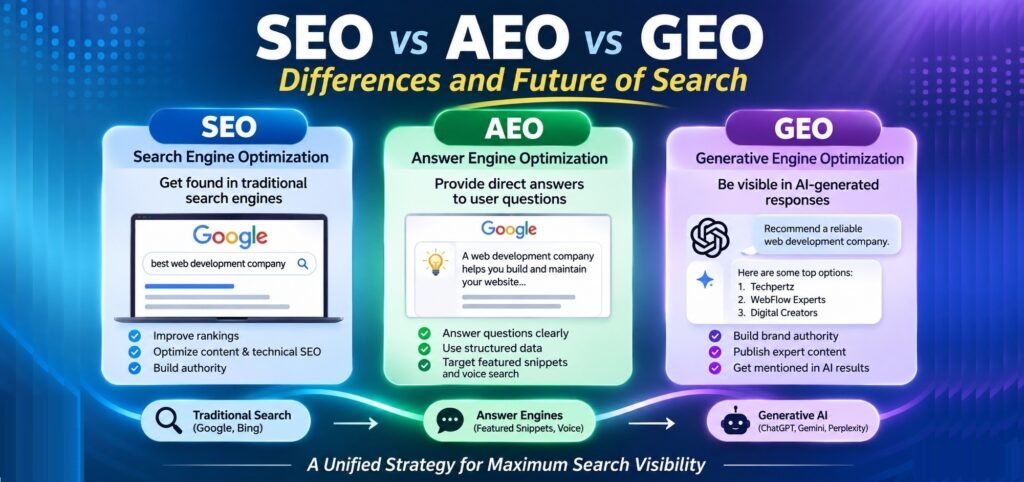
Although SEO, AEO and GEO share the common goal of improving online visibility, they approach search discovery differently. Understanding these three disciplines is becoming essential for businesses that want to remain competitive in an increasingly AI-driven digital landscape.
In this guide, we will explore SEO, AEO and GEO, explain their differences, examine how they work together, and discuss how businesses can prepare for the future of search.
What Is SEO (Search Engine Optimization)?
Search Engine Optimization (SEO) is the process of improving a website’s visibility in organic search engine results. Its primary objective is to help search engines understand website content and present relevant pages to users searching for specific information, products or services.
Traditional SEO focuses heavily on improving rankings in search engines such as Google and Bing.
For example, when someone searches for “best web development company in New York,” Google evaluates relevant websites and displays results based on numerous factors, including relevance, content quality, authority, usability and technical performance.
Key Components of SEO
1. On-Page SEO
On-page SEO involves optimizing individual website pages to improve their relevance and search visibility.
Important activities include:
- Keyword research and strategic keyword placement.
- Optimizing title tags and meta descriptions.
- Creating descriptive URLs.
- Using appropriate heading structures (H1, H2 and H3).
- Optimizing images and alternative text.
- Improving internal linking.
- Publishing valuable and relevant content.
2. Technical SEO
Technical SEO ensures that search engines can efficiently discover, crawl, render and index website content.
Common technical SEO activities include:
- Improving website loading speed.
- Implementing HTTPS.
- Fixing broken links and crawl errors.
- Optimizing XML sitemaps.
- Managing canonical URLs.
- Improving mobile usability.
- Implementing structured data.
- Resolving duplicate content issues.
3. Off-Page SEO
Off-page SEO focuses on improving a website’s authority, credibility and reputation through activities outside the website.
These include:
- Acquiring relevant, high-quality backlinks.
- Digital PR and media coverage.
- Brand mentions.
- Guest contributions.
- Industry publications.
- Building relationships with authoritative websites.
4. Content Marketing
High-quality content remains a fundamental component of SEO. Businesses need informative, original and useful content that addresses the questions and requirements of their target audiences.
Blog articles, service pages, product descriptions, case studies, guides and other resources can all contribute to organic visibility.
What Is AEO (Answer Engine Optimization)?
Answer Engine Optimization (AEO) is the process of optimizing digital content so that answer-oriented search platforms can understand it and use it to provide direct answers to user questions.
Unlike traditional search experiences, where users typically browse multiple website listings, answer engines attempt to provide relevant information directly.
For example, someone searching for:
“What is the difference between WordPress and custom PHP development?”
An answer engine may provide a summarized explanation instead of requiring the user to visit several websites.
Google’s featured snippets, People Also Ask results, voice search responses and AI-generated answers are examples of search experiences where answer-focused content can be particularly valuable.
How Does AEO Work?
AEO focuses on making information easy for search engines and AI-powered systems to understand, extract and present.
Important AEO practices include:
1. Answer Questions Directly
Create content that provides clear answers to specific questions.
For example:
- What is technical SEO?
- How much does website development cost?
- How does email marketing work?
- What is the difference between SEO and PPC?
Provide concise answers near the beginning of relevant sections before expanding into additional details.
2. Use Question-Based Headings
Structure content around the actual questions people ask.
Instead of using a generic heading such as “Website Development,” consider more descriptive headings such as:
- How Does Website Development Work?
- How Much Does a Business Website Cost?
- Which Technology Is Best for Ecommerce Development?
This makes content easier to navigate and helps search systems identify relevant information.
3. Implement Structured Data
Structured data helps search engines understand specific information on a website.
Relevant schema types may include:
- Article
- Organization
- Product
- Service
- LocalBusiness
- BreadcrumbList
- ProfilePage
FAQPage and HowTo structured data should only be implemented where appropriate, keeping in mind that Google has significantly restricted their rich-result visibility.
4. Optimize for Conversational Queries
People increasingly search using complete questions rather than short keyword combinations.
For example:
Traditional search query: “SEO company India”
Conversational query: “Which SEO company in India can help my ecommerce business increase organic traffic?”
Businesses should create content that addresses both types of search intent.
5. Establish Topical Authority
Publishing multiple useful articles around a particular subject helps demonstrate expertise and provides comprehensive information about a topic.
For example, a digital marketing agency could publish resources covering technical SEO, keyword research, link building, ecommerce SEO, local SEO and content optimization.
What Is GEO (Generative Engine Optimization)?
Generative Engine Optimization (GEO) is the process of improving a brand’s visibility, credibility and representation in responses generated by AI-powered search and conversational platforms.
These platforms include:
- ChatGPT
- Google AI Overviews and AI Mode
- Perplexity
- Microsoft Copilot
- Google Gemini
Traditional search engines generally provide a list of relevant pages. Generative search experiences can combine information from multiple sources and generate a summarized response.
For example, a user might ask ChatGPT:
“Recommend reliable digital marketing agencies specializing in ecommerce SEO.”
The AI platform may identify several companies, evaluate available information and mention selected brands in its response.
The objective of GEO is to improve the likelihood that a business’s content, expertise and brand information are discovered, understood and appropriately represented in these AI-generated responses.
How Does GEO Work?
GEO requires a broader approach than simply optimizing individual website pages.
1. Build Strong Brand Authority
AI platforms may use information from multiple sources when developing responses.
Businesses should establish a consistent and credible presence through:
- Authoritative industry publications.
- Relevant editorial mentions.
- Quality backlinks.
- Professional directories.
- Industry-specific websites.
- Genuine customer reviews.
- Consistent business information.
Brand recognition and credibility are increasingly important considerations in AI-driven discovery.
2. Publish Original and Informative Content
AI-generated responses are more useful when their underlying sources provide meaningful information.
Businesses should prioritize:
- Original research.
- Industry statistics.
- Expert opinions.
- Detailed case studies.
- Practical guides.
- Data-driven articles.
- First-hand experience.
Generic articles that simply repeat information available across hundreds of websites offer limited differentiation.
3. Make Content Easy for AI Systems to Understand
Well-organized content makes it easier for systems to identify relevant information.
Recommended practices include:
- Descriptive headings.
- Clear definitions.
- Short, informative paragraphs.
- Relevant statistics and supporting evidence.
- Descriptive tables.
- Properly attributed expert statements.
- Consistent terminology.
- Accurate and up-to-date information.
4. Strengthen Your Brand’s Digital Footprint
Your website is not the only source through which potential customers discover your business.
Maintain consistent brand information across relevant industry websites, professional profiles, social platforms, review platforms and authoritative publications.
For example, an ecommerce development company should have a consistent digital presence explaining its services, technologies, experience and areas of specialization.
5. Demonstrate Experience and Expertise
Experience, expertise, authoritativeness and trustworthiness are important quality considerations in Google’s content guidance.
Businesses should demonstrate their capabilities through real project examples, author credentials, client testimonials, documented results and detailed service information.
There is no guaranteed method to make an AI platform mention a particular business. GEO is about strengthening the quality, accessibility and credibility of information available about that business.
SEO vs. AEO vs. GEO: Key Differences
Although SEO, AEO and GEO overlap, their primary objectives and optimization approaches are different.
| Comparison | SEO | AEO | GEO |
|---|---|---|---|
| Full form | Search Engine Optimization | Answer Engine Optimization | Generative Engine Optimization |
| Primary objective | Improve organic search visibility | Become a useful source for direct answers | Improve visibility in AI-generated responses |
| Main platforms | Google, Bing | Featured snippets, voice assistants, answer engines | ChatGPT, Gemini, Perplexity, AI search |
| Content approach | Relevant, comprehensive content | Direct, question-focused answers | Credible, informative and well-structured content |
| Main focus | Rankings and organic discovery | Answer extraction and relevance | AI discovery, citations and brand mentions |
| Authority building | Backlinks and reputation | Reliable information and expertise | Brand authority and trusted external references |
| Measurement | Rankings, organic traffic, conversions | Answer visibility and relevant search features | AI mentions, citations, referral traffic and conversions |
The important thing to understand is that these three approaches are not competitors. They complement one another.
How SEO, AEO and GEO Work Together
Businesses should not treat SEO, AEO and GEO as three separate marketing strategies requiring completely different content.
Instead, they should develop an integrated search visibility strategy.
Consider an example of a company offering ecommerce website development services.
SEO approach:
The company creates an optimized service page targeting keywords such as:
- Ecommerce website development company.
- Custom ecommerce development.
- WooCommerce development services.
- Ecommerce website design agency.
The objective is to improve organic search visibility and attract relevant visitors.
AEO approach:
The company publishes useful answers to questions such as:
- How much does ecommerce website development cost?
- Which platform is best for an ecommerce website?
- How long does it take to develop an ecommerce website?
- What features should an ecommerce website have?
The objective is to provide clear answers that answer-oriented search experiences can understand and potentially surface.
GEO approach:
The company strengthens its reputation through:
- Detailed ecommerce development case studies.
- Industry publications and relevant brand mentions.
- Original research and expert contributions.
- Customer testimonials.
- Consistent company information.
- Demonstrable technical expertise.
The objective is to strengthen its chances of being recognized and referenced by generative AI platforms.
Together, these strategies create multiple opportunities for potential customers to discover the same business.
Why Traditional SEO Alone May Not Be Enough
SEO remains essential, but the way users discover information is changing.
Several developments are influencing the search landscape.
1. Growth of AI-Powered Search
Users can now ask complex questions and receive summarized responses without manually reviewing multiple websites.
Google AI Overviews, ChatGPT and Perplexity are examples of this changing search experience.
As these platforms become more widely used, businesses need to consider visibility beyond traditional organic rankings.
2. Changes in Search Behavior
Users increasingly ask conversational questions and expect contextual recommendations.
For example, instead of searching for “best CRM software,” someone might ask:
“Which CRM software is suitable for a small digital marketing agency managing 50 clients?”
Businesses need content that addresses these detailed requirements and demonstrates practical knowledge.
3. Increasing Competition for Attention
AI-generated summaries can answer certain questions directly, potentially reducing clicks to websites.
This makes it increasingly important to understand not only how many people visit a website but also how frequently a brand appears in relevant search experiences.
4. Brand Visibility Beyond Website Traffic
A business may gain visibility when an AI platform mentions its name or references its content, even if the user does not immediately visit its website.
This means digital marketing performance needs to be evaluated using a broader range of indicators.
Practical Strategies to Optimize Your Website for SEO, AEO and GEO
Businesses should adopt a unified optimization strategy instead of managing these disciplines independently.
Here are some practical recommendations.
1. Conduct Comprehensive Keyword and Question Research
Identify the keywords, questions and conversational searches relevant to your products and services.
Use tools such as:
- Google Keyword Planner.
- Google Search Console.
- Ahrefs.
- Semrush.
- AlsoAsked.
- AnswerThePublic.
Organize keywords according to search intent and build content around the information your potential customers actually need.
2. Create Comprehensive Topic Clusters
Develop a central resource around your primary service or subject and support it with relevant articles.
For example, an SEO agency could create a central SEO services page supported by articles covering:
- Technical SEO.
- Ecommerce SEO.
- Local SEO.
- Keyword research.
- Link building.
- Content optimization.
- SEO audits.
- International SEO.
Use relevant internal links to connect these resources.
3. Improve Content Quality and Originality
Avoid producing large volumes of generic AI-generated articles.
Instead, publish content that provides:
- Original insights.
- Real-world examples.
- Expert analysis.
- Practical recommendations.
- Reliable statistics.
- Supporting evidence.
AI can help with research and content production, but human expertise and editorial review remain important.
4. Implement Appropriate Structured Data
Use schema markup to describe your organization, services, products, articles and other relevant entities.
Ensure that structured data accurately represents visible page content.
Remember that schema markup does not guarantee rankings, featured snippets or AI citations.
5. Improve Technical Website Performance
A technically sound website is essential for long-term search visibility.
Focus on:
- Crawlability and indexability.
- Mobile responsiveness.
- Core Web Vitals.
- HTTPS security.
- Proper canonicalization.
- XML sitemaps.
- Logical site architecture.
- Accessible content.
Do not assume that adding special AI files or schema markup automatically makes a website visible in generative search.
6. Build Authority Through Digital PR and Brand Mentions
Earn relevant mentions and coverage from credible websites.
Contribute expert opinions, publish original research, participate in industry discussions and develop relationships with authoritative publications.
Prioritize relevance, editorial quality and genuine brand credibility rather than pursuing backlinks purely for quantity.
7. Monitor AI Search Visibility
Traditional SEO reporting should be supplemented with AI visibility monitoring.
Track:
- Whether your brand appears in relevant AI responses.
- Which pages are cited as sources.
- Which competitors are mentioned.
- How frequently your brand is recommended.
- Referral traffic from AI platforms.
- Leads and conversions originating from AI-driven discovery.
AI responses can vary depending on the platform, query, location and time, so monitoring should use a consistent set of relevant questions and repeatable testing methods.
How to Measure SEO, AEO and GEO Performance
The measurement approach should reflect the objectives of each discipline.
| Metric | SEO | AEO | GEO |
|---|---|---|---|
| Organic impressions | Yes | Yes | Indirect |
| Keyword rankings | Yes | Supporting | Supporting |
| Organic clicks | Yes | Yes | Yes, where available |
| Featured snippet visibility | Supporting | Yes | No |
| AI-generated answer mentions | No | Supporting | Yes |
| AI citations | No | Supporting | Yes |
| Brand mentions | Supporting | Supporting | Yes |
| Referral traffic | Yes | Yes | Yes |
| Leads and conversions | Yes | Yes | Yes |
Google Search Console, Google Analytics 4 and third-party SEO tools can help monitor conventional search performance.
For GEO, businesses can also use repeatable prompt testing, AI visibility tracking tools and referral analytics.
It is important to distinguish between actual referral traffic, brand mentions and source citations. They measure different aspects of visibility.
Common Myths About AEO and GEO
As these concepts gain popularity, several misconceptions are emerging.
Myth 1: SEO is dead.
Reality: SEO remains the foundation of organic search visibility. AI-powered search does not eliminate the importance of accessible, relevant and authoritative websites.
Myth 2: GEO means adding keywords for ChatGPT.
Reality: GEO involves strengthening the quality, credibility, structure and discoverability of information about a brand. Simply adding AI-related keywords does not guarantee visibility.
Myth 3: Schema markup guarantees AI citations.
Reality: Structured data helps search engines understand content, but it does not guarantee inclusion in AI-generated responses.
Myth 4: Publishing more AI-generated content improves GEO.
Reality: Content volume alone does not establish authority. Originality, accuracy, usefulness and expertise are much more important.
Myth 5: Backlinks are no longer important.
Reality: Relevant, authoritative links and credible third-party references remain valuable components of digital authority, even though no single factor guarantees AI visibility.
The Future of SEO, AEO and GEO
The future of search will likely involve a combination of traditional search engines, conversational assistants, generative search platforms and autonomous AI agents.
Users will continue to search for products, services and information, but the way they discover and evaluate businesses will become increasingly diverse.
For digital marketing agencies, this creates an opportunity to expand beyond traditional SEO packages.
Instead of focusing exclusively on keyword rankings and backlinks, agencies can offer integrated search visibility services covering:
- Traditional search engine optimization.
- Answer Engine Optimization.
- Generative Engine Optimization.
- Digital PR and brand authority.
- Technical website optimization.
- Content strategy and development.
- AI search visibility monitoring.
The objective should be to make businesses discoverable wherever their potential customers search for information.
Companies that adapt early, invest in high-quality content and build genuine digital authority will be better positioned to compete as search continues to evolve.
Conclusion
SEO, AEO and GEO represent three interconnected approaches to improving digital visibility.
SEO helps websites become discoverable in traditional search engines. AEO focuses on providing clear and relevant answers to user questions, while GEO aims to strengthen brand and content visibility in AI-generated responses.
None of these disciplines should be viewed in isolation.
Businesses need a comprehensive strategy that combines technical excellence, useful content, topical authority, digital PR and a strong online reputation.
The future of search optimization is not about choosing between SEO, AEO and GEO. It is about combining all three to ensure your business is visible, credible and discoverable across the evolving search ecosystem.
