
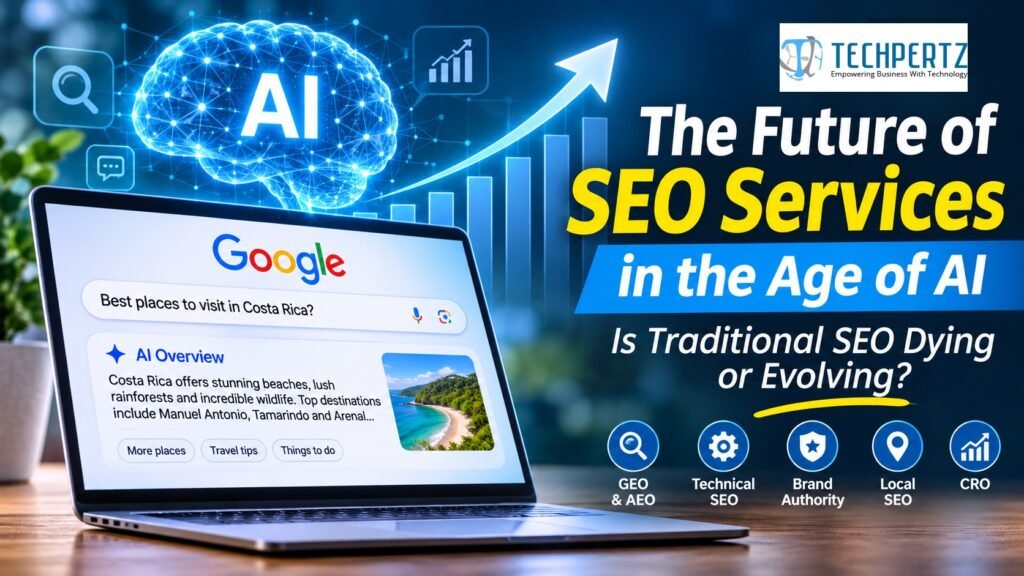
For years, Search Engine Optimization (SEO) has been one of the most effective ways for businesses to attract potential customers, increase website traffic, generate leads, and build an online presence. Businesses invested in keyword research, on-page optimization, link building, content marketing, and technical SEO to improve their positions in Google’s search results.
However, the introduction of Artificial Intelligence (AI) into search engines is changing the way people discover information online. Google’s AI Overviews, AI Mode, and conversational search experiences, along with AI-powered platforms such as ChatGPT, Gemini, and Perplexity, are transforming the traditional search experience.
Instead of browsing multiple websites to find answers, users can now ask complex questions and receive AI-generated responses that summarize information from different sources.
This raises an important question for businesses, SEO professionals, and digital marketing agencies:
What is the future of SEO services? Will traditional SEO become obsolete, or will AI create new opportunities for the SEO industry?
The answer is that SEO is not disappearing. It is evolving into a broader discipline that includes traditional search optimization, Generative Engine Optimization (GEO), Answer Engine Optimization (AEO), brand authority, and conversion optimization.
Let’s explore how AI is transforming search, what changes SEO agencies should expect, and which services will become increasingly important in the coming years.
1. How AI Is Changing the Way People Search on Google
Traditionally, users entered short keywords into Google, reviewed the search results, and clicked on websites to find the information they needed.
For example, someone planning a vacation might search for:
- Best hotels in Costa Rica
- Things to do in Jaco
- Best restaurants in Tamarindo
- Costa Rica private vacation rentals
Google would display a list of relevant websites, maps, advertisements, and other search features.
Today, users can ask more detailed questions, such as:
“What is the best area to stay in Costa Rica for a family vacation with children, and which locations offer beachfront accommodation?”
Google’s AI-powered search experiences can generate a summarized response by analyzing information from multiple sources.
This changes the search journey in several ways:
Conversational searches: Users increasingly ask complete questions rather than entering isolated keywords.
AI-generated answers: Search engines can provide summaries directly within search results.
Fewer clicks for certain searches: Users may find sufficient information without visiting individual websites.
More complex search journeys: AI Mode allows users to ask follow-up questions and explore topics through a conversational interface.
New discovery opportunities: Websites can potentially receive visibility through citations and links included in AI-generated answers.
Importantly, the growth of AI search does not necessarily mean that people are searching less. Google reported more than five trillion searches annually in 2025 and continued search growth in 2026.
The bigger change is how users interact with search results and how much website traffic individual searches generate.
2. Is Traditional SEO Losing Its Importance?
Traditional SEO is not becoming irrelevant, but some established SEO practices are losing their effectiveness when used in isolation.
For example, ranking a website for a particular keyword is still valuable. However, a first-page ranking does not automatically guarantee the same number of visitors it generated several years ago.
AI Overviews can occupy prominent positions in search results and answer questions before users reach traditional organic listings.
This is particularly relevant for informational searches.
Consider someone searching for “What are the benefits of olive oil?”
An AI-generated summary may provide an overview of the benefits, reducing the need for users to visit multiple informational websites.
However, someone searching for “Where can I buy high-quality extra virgin olive oil online?” may still want to visit product pages, compare brands, read customer reviews, and complete a purchase.
This means that the impact of AI varies depending on search intent.
How Traditional SEO Is Evolving
| Traditional SEO Approach | Evolving SEO Approach |
|---|---|
| Individual keyword targeting | Search intent and topic optimization |
| Keyword density | Content relevance and usefulness |
| Generic blog publishing | Original, experience-based content |
| Backlink quantity | Relevant links and brand authority |
| Keyword ranking reports | Visibility, traffic, leads, and conversions |
| Search engine optimization | Search and AI visibility optimization |
| Website traffic as the primary goal | Business outcomes and customer acquisition |
The fundamentals of SEO, including crawlability, indexing, technical optimization, useful content, and authoritative links, remain important.
What is changing is the overall strategy and the way success is measured.
3. The Rise of GEO and AEO: New Opportunities for SEO Agencies
Two terms increasingly discussed in the digital marketing industry are Generative Engine Optimization (GEO) and Answer Engine Optimization (AEO).
Although these practices overlap with traditional SEO, they focus on improving a brand’s visibility in AI-generated answers and answer-oriented search experiences.
What Is Generative Engine Optimization (GEO)?
Generative Engine Optimization involves improving a website’s content, authority, and online presence so that AI-powered search platforms can discover, understand, and potentially reference its information.
These platforms include:
- Google AI Overviews
- Google AI Mode
- ChatGPT
- Perplexity
- Gemini
For example, imagine a user asking ChatGPT:
“Which companies provide reliable private vacation rentals in Jaco, Costa Rica?”
A vacation rental company would benefit from having its brand, properties, services, and reputation represented accurately in relevant online sources.
GEO strategies may include:
- Publishing comprehensive and useful website content.
- Establishing topical authority.
- Creating original research and informative resources.
- Maintaining accurate business information.
- Building relevant backlinks and brand mentions.
- Implementing appropriate structured data.
- Publishing expert insights and industry-related content.
There is no guaranteed way to make an AI platform recommend a particular business. The objective is to improve discoverability, information quality, and brand credibility.
What Is Answer Engine Optimization (AEO)?
Answer Engine Optimization focuses on making content useful and accessible for search experiences that provide direct answers to users’ questions.
For example, a website offering SEO services could publish content addressing questions such as:
- How long does SEO take to produce results?
- What is the difference between SEO and GEO?
- Why has organic website traffic decreased?
- How can businesses improve their visibility in Google AI Overviews?
AEO strategies include:
- Using descriptive headings.
- Providing clear and concise answers.
- Structuring content logically.
- Including relevant FAQs.
- Using appropriate schema markup.
- Supporting answers with reliable information.
GEO and AEO should complement traditional SEO rather than replace it.
4. Five SEO Services That Will Become Increasingly Important
The changing search landscape will create opportunities for agencies willing to expand their service offerings.
Here are five areas that deserve particular attention.
1. Generative Engine Optimization (GEO)
GEO is likely to become an important component of digital marketing services.
Businesses will increasingly want to understand whether their brands appear in AI-generated recommendations and whether their websites are referenced as sources.
SEO agencies can offer:
- AI search visibility audits.
- Brand mention monitoring.
- AI content optimization.
- Competitor visibility analysis.
- Entity and brand authority development.
- AI referral traffic analysis.
However, reporting should distinguish between actual citations, brand mentions, and direct referrals. They are different forms of visibility.
2. Technical SEO
Technical SEO will remain essential regardless of how search interfaces evolve.
Search engines and AI-powered discovery systems need accessible, understandable, and well-organized information.
Important technical SEO activities include:
- Website crawling and indexing.
- XML sitemap optimization.
- Robots.txt configuration.
- Canonical URL management.
- Structured data implementation.
- Mobile usability.
- Core Web Vitals.
- JavaScript SEO.
- Internal linking.
- Website architecture optimization.
Poor technical implementation can prevent important website content from being discovered or indexed properly.
For this reason, businesses should not reduce their investment in technical SEO simply because AI tools are becoming more prominent.
3. Digital PR and Brand Authority
In the future, having a website with optimized content may not be sufficient to establish a strong online presence.
Brands will need to demonstrate credibility across the wider internet.
Digital PR can help businesses achieve this through:
- Industry publications.
- Relevant editorial mentions.
- Expert contributions.
- Interviews and media coverage.
- Original research and reports.
- Relevant partnerships.
- High-quality backlinks.
For example, a company selling olive oil could benefit from being featured in food publications, cooking resources, product comparison articles, and relevant industry websites.
Similarly, a Costa Rica tourism business could build authority through travel publications, destination guides, local tourism resources, and relevant travel websites.
The goal should be to establish a credible brand reputation, not simply accumulate backlinks.
4. Local SEO and Reputation Management
Local SEO will continue to offer significant opportunities because customers still need to find nearby businesses and service providers.
Restaurants, hotels, real estate agencies, tourism companies, medical practices, and home service providers depend heavily on local discovery.
Important local SEO activities include:
- Google Business Profile optimization.
- Local keyword targeting.
- Business information consistency.
- Customer review management.
- Local landing pages.
- Relevant local backlinks.
- Location-specific content.
- Google Maps visibility.
Reputation management will also become increasingly important.
Positive customer experiences, genuine reviews, accurate business information, and consistent brand representation can help businesses establish trust.
5. Conversion Rate Optimization (CRO)
One of the biggest changes SEO agencies should consider is shifting their focus from website traffic alone to business results.
Suppose a website receives 10,000 organic visitors every month but generates only 10 inquiries.
Another website receives 4,000 visitors but generates 100 inquiries.
The second website is potentially delivering much better business value despite receiving less traffic.
This is where Conversion Rate Optimization becomes important.
CRO services can include:
- Website UX/UI improvements.
- Landing page optimization.
- Better calls to action.
- Contact form improvements.
- Navigation optimization.
- Mobile experience improvements.
- Trust signals and testimonials.
- Booking and checkout improvements.
- Conversion tracking.
SEO agencies that combine organic visibility with conversion optimization can provide a more comprehensive service to clients.
5. Will AI Reduce the Demand for SEO Agencies?
AI will automate many routine SEO tasks, but that does not necessarily mean businesses will stop requiring SEO services.
Tasks such as keyword clustering, content outlines, meta description generation, competitor research, and basic website audits can increasingly be assisted by AI tools.
This may reduce the time required to complete certain activities.
However, businesses will continue to need professionals who can:
- Develop effective SEO strategies.
- Identify technical website problems.
- Analyze competitors.
- Understand customer search behavior.
- Build brand authority.
- Plan digital PR campaigns.
- Improve conversion rates.
- Interpret analytics.
- Connect marketing activities with business objectives.
The biggest challenge for SEO agencies will be differentiation.
If every agency offers AI-generated blog posts, automated keyword research, and basic optimization at low prices, competition will increasingly focus on price.
Agencies that offer strategic thinking, specialized expertise, high-quality execution, and measurable results will have a stronger competitive advantage.
Which SEO Activities Are Most Vulnerable to AI Automation?
| SEO Activity | Potential AI Automation |
|---|---|
| Keyword clustering | High |
| Meta title and description drafting | High |
| Basic content outlines | High |
| SEO reporting | High |
| Competitor research | Medium to high |
| Technical SEO diagnosis | Medium |
| Content strategy | Medium |
| Digital PR relationship building | Low to medium |
| Brand positioning | Low |
| Complex technical implementation | Low to medium |
| Conversion strategy | Medium |
These are indicative assessments, not measured automation percentages. Human review remains important, particularly where accuracy, business context, and technical judgment are involved.
6. How SEO Agencies Should Adapt Their Business Models
Instead of selling only traditional monthly SEO packages, agencies should consider developing integrated organic search and AI visibility services.
For example, a conventional SEO package might include:
- Keyword research.
- On-page optimization.
- Monthly blog writing.
- Link building.
- Keyword ranking reports.
A more comprehensive package could include all these activities alongside:
- GEO and AEO strategy.
- AI visibility monitoring.
- Brand authority development.
- Digital PR.
- Local SEO.
- Conversion optimization.
- Organic lead tracking.
- AI referral analysis.
This approach creates more opportunities to demonstrate business value.
Suggested Service Structure for Modern SEO Agencies
| Service Category | Core Deliverables |
|---|---|
| Traditional SEO | Technical, on-page, off-page, and content optimization |
| GEO | AI search visibility and brand discoverability |
| AEO | Question-based content and answer optimization |
| Digital PR | Editorial mentions and brand authority |
| Local SEO | Google Business Profile and local visibility |
| CRO | UX/UI and conversion improvements |
| Analytics | Traffic, leads, conversions, and revenue reporting |
Agencies should also reconsider how they communicate pricing.
Instead of focusing exclusively on the number of keywords or backlinks delivered, proposals should explain the strategy, work involved, expected deliverables, and business objectives.
SEO results cannot be guaranteed, particularly when dealing with AI-generated recommendations and third-party search platforms.
7. How Businesses Can Prepare Their Websites for AI Search
Businesses do not necessarily need to rebuild their websites to accommodate AI search.
In most cases, improving existing SEO foundations and content quality is a better starting point.
Here are some practical recommendations.
Publish Original and Helpful Content
Avoid publishing generic articles simply to target more keywords.
Instead, create content that answers real customer questions and offers something useful beyond information already available on hundreds of websites.
Include:
- Firsthand experience.
- Expert opinions.
- Original photographs.
- Case studies.
- Research and statistics.
- Practical examples.
- Detailed product or service information.
Strengthen Topical Authority
Rather than publishing unrelated articles, develop comprehensive coverage around the business’s main services and areas of expertise.
For example, a Costa Rica tourism website could create content covering:
- Costa Rica travel planning.
- Popular destinations.
- Private vacation rentals.
- Local attractions.
- Transportation.
- Adventure activities.
- Family vacations.
- Travel tips.
This creates a more comprehensive resource for potential customers.
Implement Relevant Structured Data
Structured data helps search engines understand the information presented on a website.
Depending on the business, useful schema types may include:
- Organization.
- LocalBusiness.
- Product.
- Article.
- BreadcrumbList.
- Service.
- Hotel.
- TouristAttraction.
Schema markup should accurately represent visible website content. Adding irrelevant or misleading structured data will not improve search visibility.
Improve Website Experience
Website visitors should be able to find information easily, understand the services being offered, and complete important actions without unnecessary difficulty.
Pay attention to:
- Page loading speed.
- Mobile responsiveness.
- Clear navigation.
- Descriptive page headings.
- Internal links.
- Contact information.
- Calls to action.
- Trust signals.
Build a Consistent Brand Presence
Ensure that business information is accurate and consistent across the website, Google Business Profile, relevant directories, industry publications, and social media platforms.
Building a recognizable and credible brand is a long-term investment.
8. How to Measure SEO Success in the AI Era
Traditional SEO reporting has generally focused on keyword rankings, organic traffic, impressions, and backlinks.
These metrics remain useful, but they do not provide a complete picture of modern search visibility.
Businesses should expand their reporting to include:
Organic search performance: Monitor clicks, impressions, CTR, and average positions through Google Search Console.
AI search visibility: Track brand mentions and citations in relevant AI search experiences.
Referral traffic: Identify visits originating from platforms such as ChatGPT and Perplexity through analytics tools.
Brand awareness: Monitor branded search demand, relevant online mentions, and reputation.
Lead generation: Measure contact form submissions, phone calls, booking inquiries, and other conversions.
Revenue attribution: Where possible, connect organic and AI-referred visitors with actual sales and revenue.
It is also important to understand the limitations of current reporting tools. AI visibility measurements may vary between queries, locations, user accounts, and platforms.
Google Search Console remains an important resource for monitoring Google Search performance. Businesses should not assume that every AI citation or AI-generated impression is independently measurable through standard reporting.
9. The Future of SEO Services: 2027–2030
Looking ahead, SEO is likely to become more integrated with AI, digital PR, content strategy, analytics, and conversion optimization.
Here are some developments worth watching.
AI visibility will become a standard SEO service: Businesses will increasingly ask agencies whether their brands appear in AI-generated recommendations and answers.
Search will become more conversational: Users will continue asking longer, more detailed questions and refining their searches through follow-up prompts.
Original content will become more valuable: Websites offering firsthand experience, expert knowledge, original research, and useful insights will have more opportunities to differentiate themselves.
Brand authority will become increasingly important: Businesses will need a credible online presence beyond their own websites.
SEO reporting will become more business-oriented: Clients will increasingly expect agencies to demonstrate how organic visibility contributes to leads, inquiries, and revenue.
Automation will change agency operations: AI tools will help agencies complete repetitive tasks more efficiently, allowing professionals to spend more time on strategy, analysis, and execution.
It is important to distinguish these predictions from confirmed industry developments. The exact pace and commercial impact of these changes remain uncertain.
10. Final Thoughts: SEO Is Not Dying, It Is Evolving
The introduction of AI into Google Search and other discovery platforms represents one of the most significant changes in the history of digital marketing.
However, it does not mean that traditional SEO will disappear or that businesses will no longer need search optimization.
People will continue searching for products, services, businesses, recommendations, and solutions. What is changing is how they discover information and make purchasing decisions.
For SEO professionals and digital marketing agencies, the opportunity lies in adapting to these changes rather than resisting them.
Traditional SEO will remain the foundation, while GEO, AEO, digital PR, brand authority, local SEO, and conversion optimization will increasingly complement it.
The agencies that rely exclusively on outdated tactics may struggle to remain competitive. Those that combine technical expertise, strategic thinking, AI-assisted workflows, and measurable business outcomes will be better positioned for the future.
The future of SEO is not simply about ranking higher on Google. It is about making businesses discoverable, credible, and competitive wherever their potential customers search.
